Food Choices that actually work in real life (without a special “diabetes diet”)
Why eating well with diabetes feels so confusing
If you have been diagnosed with type 2 diabetes, you have likely encountered a flood of dietary advice from your doctor, a nutritionist, a well-meaning relative, or a headline you scrolled past at midnight. Low carb. Mediterranean. Plant-based. High carb, low fat. The messages are everywhere, and they often contradict one another. When patients receive conflicting information from health professionals, media, and social contacts simultaneously, the effort to eat well loses its direction before it even begins.
What makes this harder is that eating with diabetes is not a short-term adjustment. Recommended dietary changes touch nearly every part of daily life, including meal planning, food selection, portion control, and dining out, on a lifelong basis. Rigid, one-size-fits-all approaches rarely hold up in real life, and strict dietary control can breed feelings of deprivation that make lasting change even harder to achieve.
The good news is that the science no longer points to a single correct diet for type 2 diabetes. Evidence shows that several dietary patterns, including Mediterranean, plant-based, low-glycemic index, and low-carbohydrate approaches, are all clinically effective for managing blood glucose and reducing cardiovascular risk. What matters most is finding an approach that fits your food preferences and that you can realistically sustain.
This article presents practical, flexible food strategies grounded in what the evidence supports, because the most important dietary choices are ultimately the ones you make for yourself, every day.
How food affects blood sugar
Not all food affects your blood sugar in the same way. The difference comes down to the three main macronutrients, carbohydrates, protein, and fat, and understanding how each one behaves in your body is where practical diabetes management begins.
Carbohydrates are the most immediate players. When you eat carbohydrate-rich foods, your body breaks them down into sugar, which enters the bloodstream relatively quickly. Meals high in carbohydrates, particularly those with added sugars, tend to produce the sharpest rise in blood glucose levels.
Protein and fat tell a different story. A protein-rich or fat-rich meal results in a more gradual, controlled rise in blood sugar. This does not mean carbohydrates need to be eliminated, but the proportion of each macronutrient on your plate is worth paying attention to.
Fiber adds another dimension entirely. It slows gastric emptying, reduces the rate at which carbohydrates are broken down, and slows sugar absorption, all working together to moderate blood glucose after eating. Two meals with similar carbohydrate content can produce very different blood sugar responses simply based on how much fiber is present.
Portion size is where all of this becomes practical. Even a well-composed meal can push blood sugar higher when eaten in excess. A useful starting point is thinking about your plate in proportions: how much is carbohydrate, how much is protein, how much is fiber-rich food? Small, consistent adjustments can produce clinically relevant improvements over time.
The takeaway is straightforward: meals lower in carbohydrates and higher in protein, fat, and fiber offer a more favorable blood sugar response for people managing type 2 diabetes and for those without it who are at risk.
How to build a balanced plate
Nutrition advice for diabetes can feel overwhelming, but it does not have to be. One of the most practical tools available is something you already own: your plate.
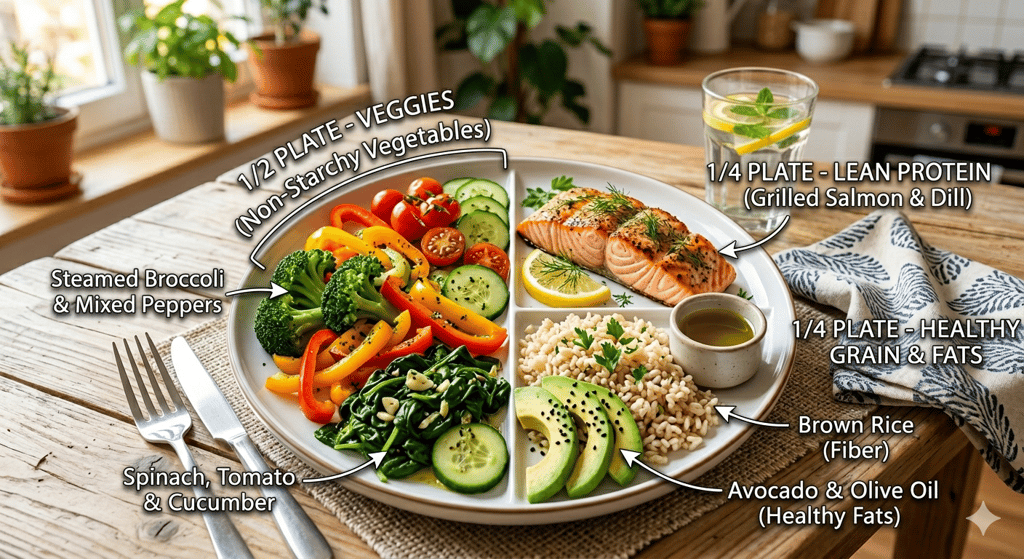
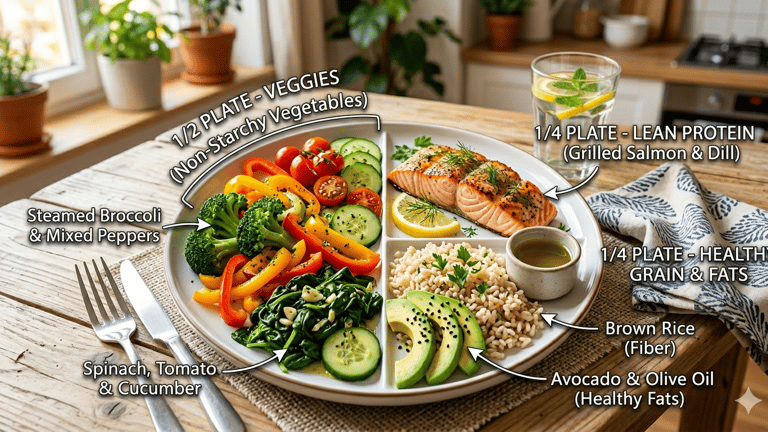
The plate method divides your plate into three sections: no measuring cups, no calorie counting, and no complicated formulas.
Half your plate goes to non-starchy vegetables. Salad, leafy greens, broccoli, and okra. These add volume and fiber without pushing your blood sugar up.
One quarter goes to lean protein. Meat, fish, eggs, or plant-based options like tofu and beans. Protein keeps you fuller for longer and produces a gentler blood sugar response than carbohydrates.
The remaining quarter goes to carbohydrates. Grains, starchy vegetables, fruit, yogurt, or beans. One quarter, not half, not three quarters.
Complete your meal with water or a low-calorie beverage.
What makes this method powerful is its flexibility. It does not ask you to give up the foods you love. A Jamaican curry, an Indian dal, a bowl of rice and stew, and all other foods can follow the plate method. The question is simply about proportions. If your meal is carbohydrate-heavy, choose just one carbohydrate source instead of combining rice, roti, and bread. Add a chopped salad on the side. Swap some rice for riced cauliflower to keep the volume without the blood sugar spike.
Small swaps add up. Replace refined grains with whole grains. Use olive oil or avocado oil in place of lard. Watch out for hidden added sugar in store-bought juices, sweetened condensed milk, and sugary beverages.
The plate method is not about eating perfectly. It is about making your plate work better for you, one meal at a time.
Practical meal ideas for breakfast, lunch and dinner
Knowing the principles is one thing. Putting them on a plate at seven in the morning is another. The good news is that one formula covers every meal:
Protein + non-starchy vegetable + carbohydrate + fat
Mix and match within each category, and you have a meal that works.
Breakfast is where most people default to carbohydrates. Shifting toward protein changes how your blood sugar behaves for the rest of the morning. Think eggs with sautéed spinach and one slice of whole-grain toast, or yogurt with a small portion of fruit and oats. Even last night's leftovers count, because there is no rule that breakfast has to look like breakfast.
Lunch and dinner follow the same structure, and it travels across cuisines without asking you to abandon familiar flavors. Grilled fish with stir-fried greens and a quarter plate of rice. A lentil curry with a side salad and a small portion of roti. A vegetable-heavy stew with lean protein built in and a chopped salad on the side.
The goal is not perfection. It is a pattern. Once the formula feels familiar, it becomes second nature.
Choosing snacks that support your blood sugar
Snacking often gets a bad reputation in diabetes management. But here is the reality: going too long without eating can leave you ravenous by your next meal, and when you are that hungry, overeating becomes almost inevitable. Aim not to go more than five hours without eating. A well-chosen snack is not cheating. It is strategy.
The key is combination. A carbohydrate eaten alone will spike your blood sugar quickly and leave you hungry again soon after. Pair it with a protein or fat, and you slow digestion down, keeping blood sugar more stable for longer. The rule is simple: never have a carb alone.
Fiber-rich snacks carry an added benefit worth knowing. Eating a fiber-containing snack between lunch and dinner can lower your blood sugar response not just after dinner, but even after breakfast the following morning. What you snack on today quietly shapes how your body responds tomorrow.
Some pairings that put this into practice: an apple with nut butter, raspberries with Greek yogurt, baby carrots with hummus, whole grain crackers with cheese, or a small handful of nuts alongside a hard-boiled egg.
Keep snacks under 200 calories, and let the protein or fiber do the heavy lifting.
Eating out and staying on track
Eating out with type 2 diabetes does not mean ordering a sad salad while everyone else enjoys themselves. It means going in with a loose plan and a couple of strategies that work quietly in the background.
Scan the menu with one question in mind
Find the protein first. Once you have your protein anchor, everything else falls into place. Look for dishes where vegetables feature prominently and treat the carbohydrate as a side decision rather than the main event. If the dish comes with fries, ask to swap for vegetables. Most restaurants will say yes. Give sauces and dressings a quick glance too, as these are often where hidden sugars accumulate unnoticed.
Two strategies that actually travel
Apply the plate method mentally before your food arrives. Eat the vegetable portion first and pace yourself through the rest. It is not about leaving food on the plate. It is about sequencing.
Watch what you drink. Sugary sodas, juices, and sweetened drinks raise blood sugar quickly and do not register as fullness the way food does. Water is the obvious choice, but if you want something else, opt for drinks without added sugar.
One more thing worth knowing: people tend to serve themselves larger portions in social settings, even before the meal begins. Simply being aware of this is enough to take the edge off it. You do not need to fight the situation. You just need to see it clearly.
Small changes that make a real difference
The biggest mistake people make when changing how they eat is trying to change everything at once. It never sticks. Start with one thing, do it consistently, and build from there.
Start with breakfast
If there is one meal worth anchoring first, it is breakfast. Skipping it disrupts your body's internal clock, blunts your insulin response, and sets off a chain reaction that makes blood sugar harder to manage all day. You do not need anything complicated. Just something with protein and fiber, eaten at a consistent time. Do that reliably for one to two weeks before changing anything else.
Eat at consistent times
Your body runs on a circadian rhythm, and your metabolism runs on it too. Irregular eating patterns reduce insulin sensitivity and cause greater blood sugar swings. Eating at roughly the same times each day gives your biology something to work with, and even small improvements in meal timing have been shown to improve glucose tolerance over time.
Keep a simple log
A notes page on your phone works fine. For one week, write down what you ate, when you ate it, and how you felt an hour or two afterward. Tired? Energized? Hungry again quickly? Over time, patterns emerge that no general advice can predict for you, because your glucose response to food is individual. A simple log turns nutrition principles into personal data you can act on.
One change at a time
Consistency with one habit beats perfection across five. Pick the section of this article that resonated most, apply it for two weeks, and notice what shifts. Then add the next thing. Small changes compounded over time are what actually move the needle.
Managing type 2 diabetes through food does not require a perfect diet. It requires a workable one. The strategies in this article are not about restriction or discipline for its own sake. They are about understanding how food works in your body and making choices that fit your real life, your flavors, your schedule, and your appetite. Start somewhere. Stay consistent. And give yourself credit for every small shift that moves you in the right direction.
References:
Anderson RM, Funnell MM. Patient empowerment: reflections on the challenge of fostering the adoption of a new paradigm. Patient Education and Counseling. 2005. https://pmc.ncbi.nlm.nih.gov/articles/PMC1783576/
Neufingerl N, Eilander A. Nutrient intake and status in adults consuming plant-based diets compared to meat-eaters. Nutrients. 2023. https://www.mdpi.com/2072-6643/15/4/861#Discussion
Koutsos A et al. Meal context and macronutrient composition influence postprandial glucose responses. Frontiers in Nutrition. 2024. https://www.frontiersin.org/journals/nutrition/articles/10.3389/fnut.2024.1395745/full#sec14
Postprandial glucose and hormonal responses to macronutrient composition. PMC. 2025. https://pmc.ncbi.nlm.nih.gov/articles/PMC11884502/#sec3
Portion control and glycemic outcomes in type 2 diabetes. PMC. 2023. https://pmc.ncbi.nlm.nih.gov/articles/PMC10390788/#sec21
The plate method in diabetes nutrition education. Nutrients. 2024. https://pmc.ncbi.nlm.nih.gov/articles/PMC11548221/#sec5-nutrients-16-03771
Dietary fiber snacks and postprandial glucose response. Foods. 2020. https://pmc.ncbi.nlm.nih.gov/articles/PMC7589548/#sec4-foods-09-01500
Cleveland Clinic. Smart snacking for type 2 diabetes. https://health.clevelandclinic.org/snacks-for-type-2-diabetes
Meal frequency, circadian rhythm, and glycemic control in type 2 diabetes. PMC. 2024. https://pmc.ncbi.nlm.nih.gov/articles/PMC10903815/#sec019.