Using Diabetes Technology Without Feeling Overwhelmed
Why diabetes technology does not have to feel overwhelming
If you have heard about continuous glucose monitors, insulin pumps, or diabetes apps and felt more overwhelmed than reassured, you are not alone. Diabetes technology is advancing quickly, and the promise it holds is real. But the gap between what these devices can do and how they actually feel to live with day to day is not something that gets talked about enough. Wearing a device on your body, interacting with it constantly, troubleshooting it when something goes wrong, and explaining it to people around you. These are not small things. The emotional, social and practical demands of using diabetes technology are significant, and for many people, they quietly get in the way of getting the most from it. This guide is not about adding more to your plate. It is about helping you understand what these tools actually do, in plain language, so that technology becomes something that works for you rather than another source of stress. Because when it is used well and when it fits your life rather than fighting against it, diabetes technology has the potential to genuinely improve your day-to-day experience of managing this condition. The goal here is not perfection. It is simply feeling a little more in control.
What to track and why
When you start monitoring your blood sugar, it can feel like you are chasing a number. You check, you see a result, and you either feel relieved or unsettled. But that is not really what monitoring is for.
The goal is not to hit a perfect number every time. It is to see patterns. What happens to your blood sugar before and after meals. How it behaves overnight. What a stressful day or a disrupted night of sleep does to it. That bigger picture is where the useful information lives.
There are a few core things worth tracking. Your fasting level, taken first thing in the morning before eating, gives you a baseline. Pre-meal readings tell you where you are starting from. Post-meal readings, taken around two hours after eating, show you how your body responded to what you ate. Over time, these readings together reveal patterns that a single snapshot never could.
If you are using a continuous glucose monitor, you will also hear about something called time in range. This refers to how much of your day your blood sugar spends within a target zone, generally between 70 and 180 mg/dL. Rather than one reading at one moment, it gives you a fuller picture of how your glucose is moving across the whole day and night.
Whether you are using a finger-stick method or a CGM, the principle is the same. You are not looking for perfection. You are looking for information. And the more consistently you track, the more clearly the patterns emerge.
How and when to check your blood sugar
A glucose meter is the most common starting point for monitoring your blood sugar at home. It is straightforward to use. You prick the side of your fingertip with a small lancet, place the drop of blood on a test strip, and within seconds, the meter shows you a reading. That is it. The fingertip is recommended for most checks because it gives the most accurate result, particularly after meals or during exercise when blood sugar is changing quickly. Some meters can read from other sites like the forearm or palm, but these are less reliable at those moments, so the fingertip remains the standard. When you test matters as much as how often you test. Most people are asked to check at similar points in the day. First thing in the morning before eating gives you a fasting reading, which is a useful daily baseline. Before and roughly two hours after meals shows you how your body is responding to food. A bedtime check gives you a picture of where your levels are heading overnight. Your healthcare provider will advise on the frequency that makes sense for your situation, but these are the moments that tend to come up most consistently. Keeping a record of your results is important, and it does not need to be complicated. A written diary works perfectly well if that is your preference. Note the date, time, your reading, and anything relevant alongside it such as what you ate or whether you exercised. If you prefer something digital, many meters connect directly to an app that captures readings automatically, removing the need to enter anything manually. Some people simply take a photo of the meter screen after each check. Any of these approaches works. The goal is simply that the information is there when you or your provider needs it. Bring your meter, your app, or your written record to every appointment. Your provider can spot patterns in your results that are easy to miss day to day, and having the data in front of them makes that conversation much more useful.
What a continuous glucose monitor does and whether it might be right for you
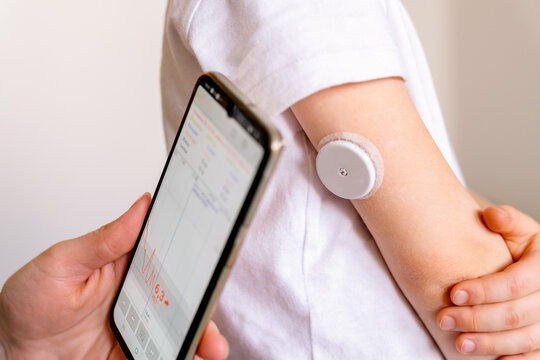
A continuous glucose monitor, or CGM, is a small device that tracks your glucose levels around the clock. Rather than giving you a single reading at one moment in time, it builds a continuous picture of how your blood sugar is moving across the day and night. A finger stick check tells you where you are. A CGM tells you where you are, which direction you are heading, and how quickly. That additional context is particularly useful for spotting patterns that would otherwise stay hidden, such as blood sugar rising overnight or dropping after a particular meal. One of the most practical features of a CGM is the trend arrow. This is a directional indicator on your device or app showing whether your glucose is currently rising, falling, or holding steady. These arrows allow you to anticipate what might happen next, rather than simply reacting to where you already are. CGMs can also send alerts when your glucose moves outside a target range, which many people find reassuring overnight or during exercise. Like all technology, CGMs can occasionally give inaccurate readings, and a finger stick check may still be needed if a reading does not match how you are feeling. They also require a sensor worn on the body, which takes some adjustment. Whether a CGM is right for you depends on your individual situation and what your healthcare provider recommends. Some people use them continuously. Others use them for a set period to get a clearer picture of their glucose patterns at a specific point in their care.
Apps and digital tools that can make tracking easier
If you are already monitoring your blood sugar, an app can make that process significantly simpler. Rather than writing results down by hand or trying to remember what your levels were doing last Tuesday, an app stores everything in one place and often does the analysis for you. Averages, patterns, how often you are going above or below your target range. It surfaces the information that would otherwise take time to piece together yourself. Apps broadly fall into a few categories. Some are primarily for logging, capturing your readings, meals, medications, and activity in one place. Some connect directly to your glucose meter or CGM and record everything automatically, removing the need to enter anything manually. Others focus on reminders, prompting you to check at the right times or take your medication. Many do a combination of all three, and some can share your data directly with your healthcare provider, which can make appointments more useful. The risk with all of this is overload. More data does not automatically mean better management, and trying to track everything at once is one of the quickest routes to switching everything off and going back to basics. A more practical approach is to start small. One device. One app. One or two metrics that actually matter to you right now. Get comfortable with that before adding anything else. The goal is for technology to reduce the mental load of managing diabetes, not add to it. If an app is making you feel more anxious rather than more informed, that is useful information in itself.
Turning data into small changes
The most common mistake with blood sugar data is checking it too often and too anxiously. Glancing at your readings every hour does not give you useful information. It gives you noise. What you are looking for is patterns, and patterns only become visible when you step back and look across a longer stretch of time. A weekly review is a more useful habit than hourly monitoring. Once a week, look at your readings across the past seven days. Not to judge individual numbers, but to notice what keeps happening. That is where the actionable information lives. A few examples of what that might look like in practice. If your readings are consistently high after dinner, that is a signal worth exploring. It might point to portion size, the composition of that meal, or how much you moved afterwards. If your fasting levels are regularly higher than expected, it may be worth looking at what you ate in the evening or how your sleep has been that week. If your levels are more variable on certain days, consider what was different. Stress, disrupted sleep, and changes in activity all leave a visible mark on your data. One pattern. One small adjustment. Notice what shifts. Then look again next week.
Technology is a tool, not a test
Diabetes technology works best when it is in service of your life, not the other way around. A glucose reading is not a verdict. A week of variable data is not a failure. It is information, and information is only useful if it helps you make one small, sustainable change at a time. The devices and apps covered in this guide are not about doing more or monitoring yourself more intensely. They are about seeing your blood sugar more clearly so that the decisions you make day to day are based on something real rather than guesswork. You do not need to figure out every pattern alone. Your healthcare provider can look at the same data you are looking at and spot things that are easy to miss when you are living inside it. Bringing your data to appointments turns those conversations into something genuinely useful. That is what it is for. Start with one thing and get comfortable with it before adding anything else. If something is causing more anxiety than clarity, that is worth saying out loud, to yourself and to your care team. The goal has never been perfection. It has always been feeling a little more in control.
References:
Tanenbaum, M. L., & Commissariat, P. V. (2023). Experience with burdens of diabetes device use that affect uptake and optimal use in people with type 1 diabetes. Endocrine connections, 12(10), e230193. https://doi.org/10.1530/EC-23-0193
Edelman, S., Cheatham, W. W., Norton, A., & Close, K. L. (2024). Patient Perspectives on the Benefits and Challenges of Diabetes and Digital Technology. Clinical diabetes : a publication of the American Diabetes Association, 42(2), 243–256. https://doi.org/10.2337/cd23-0003
Aleppo G. (2021). Clinical Application of Time in Range and Other Metrics. Diabetes spectrum : a publication of the American Diabetes Association, 34(2), 109–118. https://doi.org/10.2337/ds20-0093
Cleveland Clinic. (n.d.). Blood sugar monitoring. Cleveland Clinic. https://my.clevelandclinic.org/health/treatments/17956-blood-sugar-monitoring
Mayo Clinic Staff. (n.d.). Blood sugar levels: What is normal? Mayo Clinic. https://www.mayoclinic.org/diseases-conditions/diabetes/in-depth/blood-sugar/art-20046628
Cornejo, C. (2021, December 17). Using an app to track blood sugar levels from your glucose meter. Beyond Type 1. https://beyondtype1.org/diabetes-apps-with-glucose-meters/
Miller E. M. (2020). Using Continuous Glucose Monitoring in Clinical Practice. Clinical diabetes : a publication of the American Diabetes Association, 38(5), 429–438. https://doi.org/10.2337/cd20-0043
Grazia Aleppo, Lori M Laffel, Andrew J Ahmann, Irl B Hirsch, Davida F Kruger, Anne Peters, Ruth S Weinstock, Dennis R Harris, A Practical Approach to Using Trend Arrows on the Dexcom G5 CGM System for the Management of Adults With Diabetes, Journal of the Endocrine Society, Volume 1, Issue 12, 1 December 2017, Pages 1445–1460, https://doi.org/10.1210/js.2017-00388
Bober, T., Garvin, S., Krall, J., Zupa, M., Low, C., & Rosland, A. M. (2025). Examining How Adults With Diabetes Use Technologies to Support Diabetes Self-Management: Mixed Methods Study. JMIR diabetes, 10, e64505. https://doi.org/10.2196/64505
Alaslawi, H., Berrou, I., Al Hamid, A., Alhuwail, D., & Aslanpour, Z. (2022). Diabetes Self-management Apps: Systematic Review of Adoption Determinants and Future Research Agenda. JMIR diabetes, 7(3), e28153. https://doi.org/10.2196/28153